
Who will bring Tax Justice to Wales? Assessing the 2026 Assembly Manifestos
How Welsh Assembly election manifestos line up against our five day‑one tax justice recommendations, to deliver local and national change?
The Welsh election is in full swing, with a potential political earthquake on the horizon in May. Recent opinion polls suggest Plaid Cymru is heading for victory. If that victory materialises it will be the first time anyone other than Labour has won in Wales since the collapse of the Liberals after World War One.
But what does the election mean for tax justice? Well, potentially a lot. The Welsh Assembly (or Senedd Cymru) has some, limited powers to set taxation policy, and the signals sent by the election will no doubt reach Westminster too.
Ahead of the election, we sent out our policy recommendations for delivering tax justice to all the parties standing in Wales. As well as supporting UK-wide policies such as a wealth tax, and an end to tax haven secrecy, we made 5 recommendations for policies within the Welsh assembly’s power to deliver on day one (see summary below table). So, who adopted our recommendations, and how do their manifesto promises stack up in terms of delivering on tax justice?
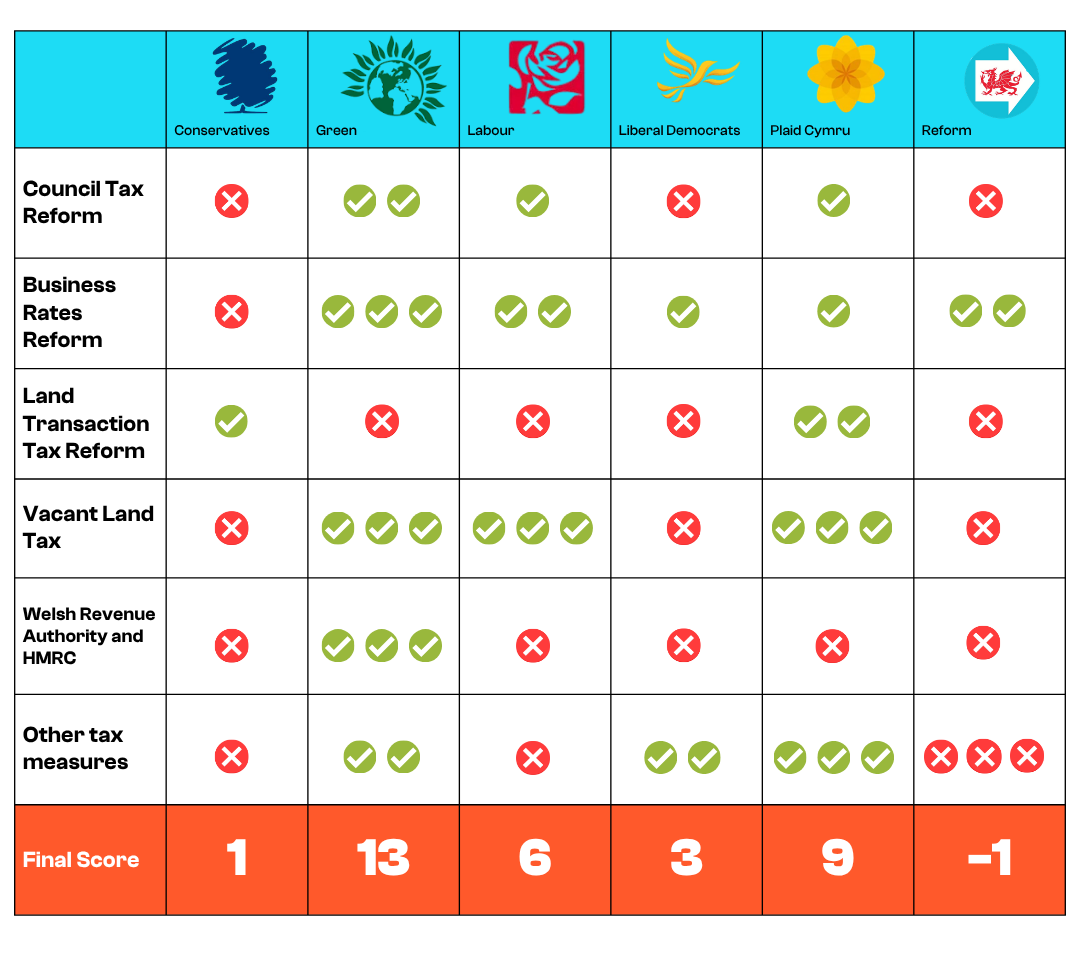
Methodology: policies are scored on from 0 (no commitment), 1 (positive step but not fully aligned), 2 (very positive step) or 3 (full alignment/share approach with TJUK policies). When a proposed policy runs counter to TJUK’s goal of a fairer tax system where the wealthiest pay their fair share and would actually make things worse (such as tax cuts for the wealthiest) we have given negative scores.
-
Make sure the richest pay the highest council tax → Reform Council Tax Make property tax proportional so people in cheaper homes pay less while owners of high‑value properties finally pay their fair share.
-
Make wealthier second‑home buyers pay more → Rebalance Land Transaction Tax Charge much higher rates on second homes, speculative investments and holiday lets so wealthy buyers stop pricing out local people.
-
Stop penalising small local businesses → Reform Business Rates Stop penalising small high‑street businesses while big multinationals pay less; create a fairer, more predictable system.
-
End unproductive land hoarding → Introduce a Vacant Land Tax Tax landowners who sit on unused land with planning permission, pushing them to build or sell instead of hoarding.
-
Crack down on super-rich tax dodging → Resource WRA & HMRC properly Give tax authorities the staff and tools to close the tax gap and ensure the super‑rich actually pay what they owe.
LABOUR
On tax justice issues, Labour has a good record in Wales having legislated for Council Tax revaluation; an essential step to progressively reforming our broken property taxes. Mark Drakeford, who isn’t standing, will be missed by many advocates for tax justice. Labour have pledged to not raise Income Tax rates, make Council Tax fairer for everyone, introduce a Vacant Land Tax to tackle land banking by developers and a root and branch review of Business Rates to make them fairer. We have asked for clarification on what exact form this will take— we received no reply so have scored this on the basis of revaluation of Council Tax bands due in 2028.
CONSERVATIVES
The Conservative manifesto was published some time ago— this author hears rumours that the Conservative staffers who wrote it defected to Reform as it was being finalised prompting a race to publish it— promising a 1p cut to the basic rate of Income Tax, limits on Council Tax rises and public spending cuts in order to pay for this. They have focused their efforts on cutting back on perceived wasteful spending, and IFS has judged their plans as not credible given the little spent on this.
The Conservatives have also promised to abolish the Land Transaction Tax (Wales’s version of Stamp Duty) on main residencies. Whilst LTT is an economically inefficient tax and its replacement is desirable, this approach in practice would be a tax cut for the richest half of society. More comprehensive reform, ensuring the wealthiest pay the most, is essential. The Conservatives have also promised to abolish Business Rates for small businesses, paying for this with massive cuts to public services.
REFORM
The Reform manifesto has promised to cut 1p of each band of Income Tax and cap Council Tax rises to help with the cost of living; which will be paid for by savage cuts to public services, and in practice would see more money going into the pockets of higher income earners. They have also pledged a “Tax Lock” which would see no new taxes introduced, throwing away any chance of meaningful reform to Welsh taxes and depriving public services of much needed revenue. Reform has also promised a root and branch review of the Business Rates to promote economic growth, which is to be welcomed. Overall, Reform’s plans will see tax cuts for the better off, funded by massive cuts to public services that Wales cannot afford.
THE GREEN PARTY
The Welsh Greens manifesto contains some great proposals, taking significant steps to tax wealth more as part of a wider progressive agenda. These will substantially improve the lives of people in Wales, as well as promoting economic growth. This includes replacing Council Tax and Business Rates with a Land Value Tax paid by landowners, introducing a Vacant Land Tax and resourcing the Welsh Revenue Authority to collect the right amount of tax. They also call for the UK to introduce polluter pays principle taxes on luxury goods and highly polluting industries – an essential step in tackling the climate crisis.
PLAID CYMRU
Plaid Cymru’s manifesto makes a range of tax pledges. On Council Tax, they promise to reform it to make it fairer. On Business Rates, they have promised to reform and rebalance them so high streets pay less whilst larger, out-of-town businesses pay more. Tax Justice UK welcomes these aims but it is not clear how exactly Plaid will achieve them or what reform will look like. Like Labour and the Greens, Plaid also call for the introduction of a Vacant Land Tax. They also call for lower rates of Land Transaction Tax for first time buyers.
Plaid’s manifesto also has the largest range of additional tax proposals. They call for greater devolution of income tax powers and vow to make them more progressive, pledge to challenge the UK government on any further changes to inheritance tax that might impact farmers, to review rules around taxes on second homes and holiday lets, and for a polluter pays approach to taxing polluting industries. Whilst some of these, such as making income tax more progressive, is to be welcomed, other proposals such as cutting taxes on second homes and holiday lets during a housing crisis is not the way forward.
LIBERAL DEMOCRATS
The final manifesto was from the Liberal Democrats who have been quite light on tax proposals. They have called for regular reviews of business rates relief thresholds and for a plan for long term reform, together with making the covid-era Business Rate relief on retail, leisure and hospitality sectors permanent. They have also called for the full implementation of the Silk Commission proposals which would give Wales the same Income Tax powers as Scotland, as well as the devolution of Air Passenger Duty to Wales. The Liberal Democrats have also acknowledged that more money is needed for funding adult social care and opted for a broad-based tax rise of 1p on each band of Income Tax. Whilst it is welcome to see a political party acknowledge taxes need to rise in order to fund public services, there were missed opportunities here to reform taxes on wealth.
With the Greens, Plaid, Labour, Reform and the Lib Dems promising to make Business Rates fairer, and several parties promising fairer Council Tax – we hope to see progressives work together in the next Senedd to introduce meaningful structural change to Wales’s tax system. Tax Justice UK will be urging successful parties to grip the bull by the horns and deliver the change that Wales needs— and show leadership to the rest of the UK.